The author's voice
An introduction to the publication and its approach, an audio or video interview.
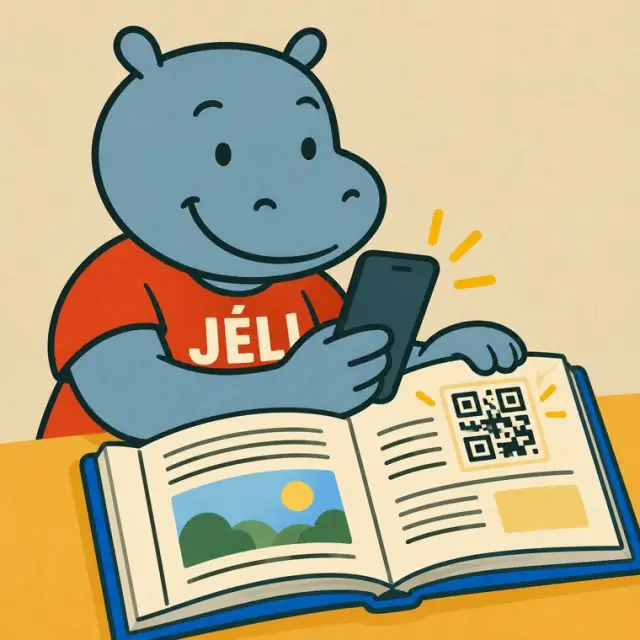
Book, article, thesis, dissertation, report, journal… A QR code on the cover, in the chapters or next to a figure opens a JeliCard: the author's voice, readings in national languages, images, links to your data and supplementary documents, and news of your publications.
A book, an article or a thesis can no longer change after printing, and the link with the reader ends at the last page.
Swipe to see the examples.
An introduction to the publication and its approach, an audio or video interview.
Readings of passages or a summary in French and in national languages.
Audio summary, maps, photos, videos, links to supplementary documents.
For an article or a thesis: links to your data, questionnaires and appendices, a video of the defence.
Corrections and new information without reprinting.
New releases, where to buy, talks, meet-the-author events and book signings.
A JeliCard is shared in one move: by text message, on social media, by email, on the internet, or simply by scanning the QR code from one phone to another. Your message travels across time and distance, and reaches every audience, here and elsewhere.
These tools are excellent, and you probably use them already. Jèli does not replace them: it does a different job.
Social media makes your publications known. Jèli is inside the publication itself: readers scan the page they are reading and find the content for that exact chapter, without leaving their reading to look for an account.
It's not one or the other. Put the links to your Instagram, TikTok and WhatsApp accounts in the text of your JeliCard, and share your JeliCard on your networks: each tool does what it does best.
Start with one publication, then the whole collection.
The publication ends at the last page. The JeliCard keeps the conversation with the author going.
Your first JeliCard is ready in a few minutes.