← Home
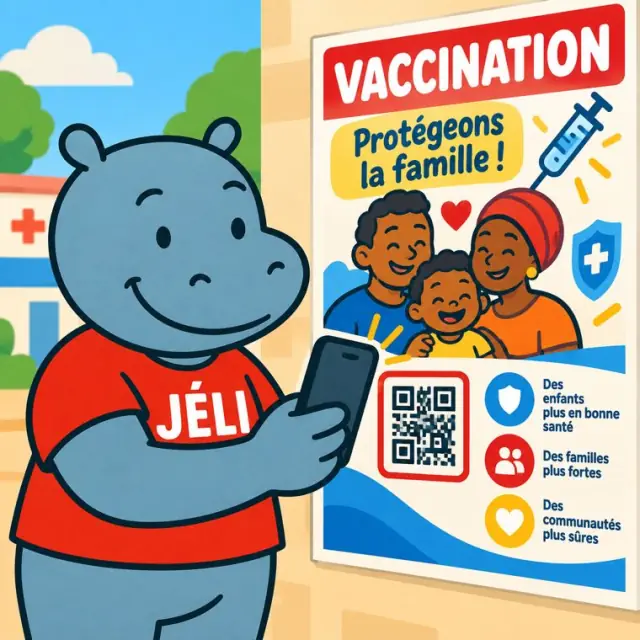
Malini scans the QR code on a vaccination poster
Posters and communication tools

Give a voice to your posters and documents.

Vaccination, school, seeds, civil registration, water, elections… Add a Jèli QR code to the posters and communication materials of your programmes: everyone listens to the message in their own language, with no app and no ads.

  • NGOs
  • Associations
  • Local authorities
  • Government services
  • Technical and financial partners
  • Community organisations
  • Event organisers

1The problem: a written poster or document for audiences who listen

The poster or communication document is written in French, but a large part of the public gets its information by word of mouth, in a national language: women, older people, young people out of school, rural communities. Yet they are the very people most campaigns are aimed at.

Limited spaceOpening hours, addresses, conditions and advice don't fit on a poster or a leaflet.
Fixed contentA change of date or place means reprinting.
One message for allThe same national document doesn't give the contacts of the local service in each neighbourhood.
Invisible impactNo one knows how many people actually looked at the message.

2The solution: the poster or document + a QR code + a JeliCard

The poster or document stays simple and official. The JeliCard carries the full message.

  1. The poster or documentA strong image, a short slogan in French, the partners' logos and a clearly visible QR code: “Scan to listen in Bambara, Fula, Songhay…”
  2. The scanThe phone's camera reads the QR code and opens the JeliCard.
  3. The JeliCardVoice messages in national languages, detailed text in French, images. Addresses and numbers written in the text become links to tap.

No app to download.The JeliCard is a web page: no storage to free up, no account to create, no costly download.

3Two ways to print the QR code

National

One QR code on the poster or document

The same QR code on every poster and every document, a single JeliCard. The simplest and cheapest option for a message that is the same everywhere.

Local

One QR code sticker per place

Stuck on the poster or document, it opens the JeliCard of the town, the neighbourhood, the school, the market or the health centre.

  • Familiar voices: the service officer, the community relay, the neighbourhood chief, the head of an association or club, a respected member of the community.
  • Familiar images: the place, the building, the team.
  • Local contacts: address, opening hours, numbers of the nearest service.
  • A relay person changes? You replace the voice message and the contact; the sticker stays where it is.

The two can be combined: a national QR code on the poster or document and, where it helps, a local sticker.

4What Jèli gives you

Language fairnessThe message is heard in the audience's language, including by people who don't read French.
Instant accessIt opens in the browser, with no app and no sign-up.
Complete informationOpening hours, free services, conditions, addresses and numbers fit on the card, not on the poster or document.
Updates without reprintingA new site or new dates are corrected on the JeliCard in a few minutes. The poster already up or the document already handed out stays valid, even for the next campaign.
Local adaptationOne poster or one document can lead to a card for each town or neighbourhood.
TrustA familiar voice makes the message credible and helps counter rumours.
Group listeningA relay person scans and plays the voice message to a group: a community talk, the market, a grin. No need for a smartphone each.
Reach trackingThe number of times the JeliCard is opened, per day and per country, gives a useful indicator for your reports to donors.
Free and ad-freeNo ads: the person who scans sees only your message. The only cost: printing the QR code or the stickers.

Your JeliCards travel around the world

A JeliCard is shared in one move: by text message, on social media, by email, on the internet, or simply by scanning the QR code from one phone to another. Your message travels across time and distance, and reaches every audience, here and elsewhere.

  • SMS
  • WhatsApp
  • Social media
  • Email
  • Internet
  • Scan from phone to phone

?What about Instagram, TikTok, WhatsApp?

These tools are excellent, and you probably use them already. Jèli does not replace them: it does a different job.

Instagram and TikTok The networks that help people discover you
Ideal for
showing your news in photos and videos, and reaching new audiences.
Information
lives in a feed: new posts push the old ones down.
Access
mostly needs the app and an account; the algorithm decides who sees what.
Around it
other content and ads are shown too.
WhatsApp The messaging app that gets people talking
Ideal for
everyday conversations, answering questions, running a group.
Information
lives in a conversation: messages pile up and old ones are quickly lost.
Access
means having your number or being in the group.
Around it
are all the person's other conversations.
Jèli The reference page, in the right place
Ideal for
information that must stay available, attached to an object, a poster or a place.
Information
lives on a stable page: always in the same place, always up to date.
Access
takes a simple scan, with no account and no app.
Around it
no ads and no one else's content: only your message and your other JeliCards.

Social media makes your campaign known and WhatsApp spreads the information through groups. Jèli is on the poster or document, in the neighbourhood: it also reaches people who don't follow you online, and gives them the approved message, in their language, with no ads next to it.

It's not one or the other. Put the links to your Instagram, TikTok and WhatsApp accounts in the text of your JeliCard, and share your JeliCard on your networks: each tool does what it does best.

5Examples by field

Swipe to see the examples.

Health

Vaccination campaign

On the poster: Vaccinated on time, protected for life

In the JeliCard: Voice messages on the vaccination schedule, vaccination days and places, the health worker's number.
Education

Getting girls into school and keeping them there

On the poster: A girl in school, a family moving forward

In the JeliCard: Audio testimonies from parents, enrolment dates, documents, school contacts.

Agriculture

Improved seeds

On the poster: Good seed, good harvest

In the JeliCard: Sowing advice by voice, steps in pictures, where to buy, the farm adviser's number.

Civil registration

Registering births

On the poster: A child registered, a child recognised

In the JeliCard: Procedures and deadlines by voice, documents to bring, addresses of civil registry offices.

Water and sanitation

Handwashing and latrines

On the poster: Clean hands save lives

In the JeliCard: Steps in pictures, a voice message from a relay person, an alert number, safe drinking water points.

Environment

Fighting bush fires

On the poster: Protect the bush, protect our harvests

In the JeliCard: Instructions by voice, emergency numbers, a map of high-risk areas.

Employment

Youth training

On the poster: Your trade, your future

In the JeliCard: Audio presentation of the programme, criteria, schedule, place and contacts for enrolment.

Social protection

Household support programme

On the poster: Your right, your support

In the JeliCard: Eligibility conditions by voice, documents, where to register, an information line.

Citizenship

Registering on the electoral roll

On the poster: Register, make your voice heard

In the JeliCard: Procedures by voice, documents to bring, dates and registration offices.

6How to do it, step by step

A pilot on one campaign and one or two districts can be tested in a few weeks.

  1. Choose the campaign and the national languages spoken in the area.
  2. Write and approve the key message with the relevant technical service.
  3. Record the voice messages with well-known local voices; have the translation of technical terms checked.
  4. Create the JeliCard : voice messages, text with addresses and numbers, images. Test the link on several phones and networks.
  5. Print the QR code on the poster or document, or on stickers for each place, with the words “Scan to listen”.
  6. Train the relay people to scan and play the voice messages to groups.
  7. Monitor and adjust the content based on feedback from the field.

7Obstacles, and how to get past them

Not everyone has a smartphoneGroup listening organised by community relays. The poster or document still makes sense on its own.
Costly data, weak networkShort voice messages (under a minute), light images, no app to download.
Few people know QR codesThe words “Scan to listen” on the poster or document, and a demonstration during community talks.
Accuracy of messagesTexts and translations approved by the technical services or the relevant authorities.
Keeping content aliveName a person in charge of updates and plan who takes over the cards when the project ends.
Personal dataNever publish any personal data about beneficiaries on the JeliCards.

8Monitoring indicators

  • Number of openings per placeStatistics for each local JeliCard
  • Group listening sessions and participantsRelay reports
  • Understanding of the key messageQuick survey of a sample
  • Attendance at the promoted serviceService registers
  • Updates without reprintingProject monitoring

Our recommendations

  • Run a pilot on a priority campaign in your programme.
  • Include the JeliCard in the communication budgets of your next projects: the extra cost is marginal.
  • Involve the relevant authorities from the start to approve the messages.
  • Get community relays on board for group listening.
  • Share your results with other organisations so voice messages can be pooled.
  • Don't forget your business card: your name and a QR code that leads to all your activities.
A poster or document in French informs those who read. With a JeliCard, it speaks to the whole community, in its own language.
Back to the home page

Make your QR codes talk.

Your first JeliCard is ready in a few minutes.

App Store Google Play