The commentary on the work
Voice messages in several languages: visitors choose their own.
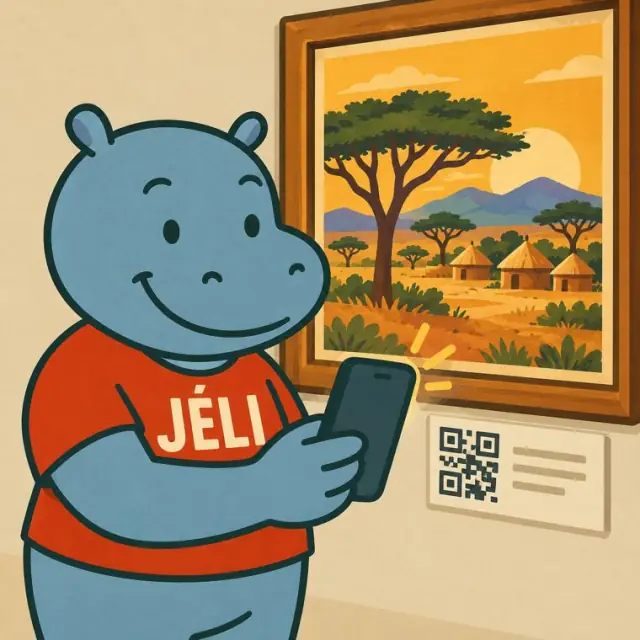
A work on display, an art object, a family heirloom: a QR code next to it opens a JeliCard. Visitors listen to the commentary in their own language, hear the artist's voice, discover the story of the object and everything the label can't say.
The label gives a title, a date, a technique. Visitors often leave without the story of the work.
Swipe to see the examples.
Voice messages in several languages: visitors choose their own.
The artist talks about the work, the technique, and what inspired it.
Its origin, its provenance, the hands it has passed through, how it was bought or handed down.
Sketches, stages of creation, details invisible to the naked eye.
A link to your catalogue and your press kit, to open on the phone.
Price and availability, with the gallery's WhatsApp link or email written in the text.
A JeliCard is shared in one move: by text message, on social media, by email, on the internet, or simply by scanning the QR code from one phone to another. Your message travels across time and distance, and reaches every audience, here and elsewhere.
These tools are excellent, and you probably use them already. Jèli does not replace them: it does a different job.
Instagram and TikTok bring in the public, and WhatsApp helps organise group visits. Jèli takes over in front of the work: visitors scan and listen to the commentary, without looking for your account or scrolling through a feed.
It's not one or the other. Put the links to your Instagram, TikTok and WhatsApp accounts in the text of your JeliCard, and share your JeliCard on your networks: each tool does what it does best.
One JeliCard per work, or one per room.
The label names the work. The JeliCard makes it speak, in each visitor's language.
Your first JeliCard is ready in a few minutes.